Thailand has long been a dream destination for international buyers seeking tropical lifestyles, strong rental returns, and relatively affordable luxury property. “Whether you’re investing in a beachfront condo in Phuket” is one of the most common questions foreign buyers ask.
“Can owning property in Thailand help me get a visa?”
The short answer: property ownership alone does not grant residency or a visa. However, there are several visa options that property owners can use to live in Thailand long-term. This guide explains all relevant visa pathways clearly—especially for buyers from Europe, the UK, the US, Australia, Russia, and Singapore.
Understanding the Basics: Property Ownership vs Residency
Unlike some countries, Thailand does not offer a direct “golden visa” tied purely to real estate ownership. Buying a condo or villa—even at high value—does not automatically entitle you to residency.
However, property ownership can complement and strengthen your visa strategy by:
- Supporting proof of financial stability
- Demonstrating long-term commitment to Thailand
- Providing a fixed address for immigration purposes
With that in mind, let’s explore the visa options that do work for property owners.
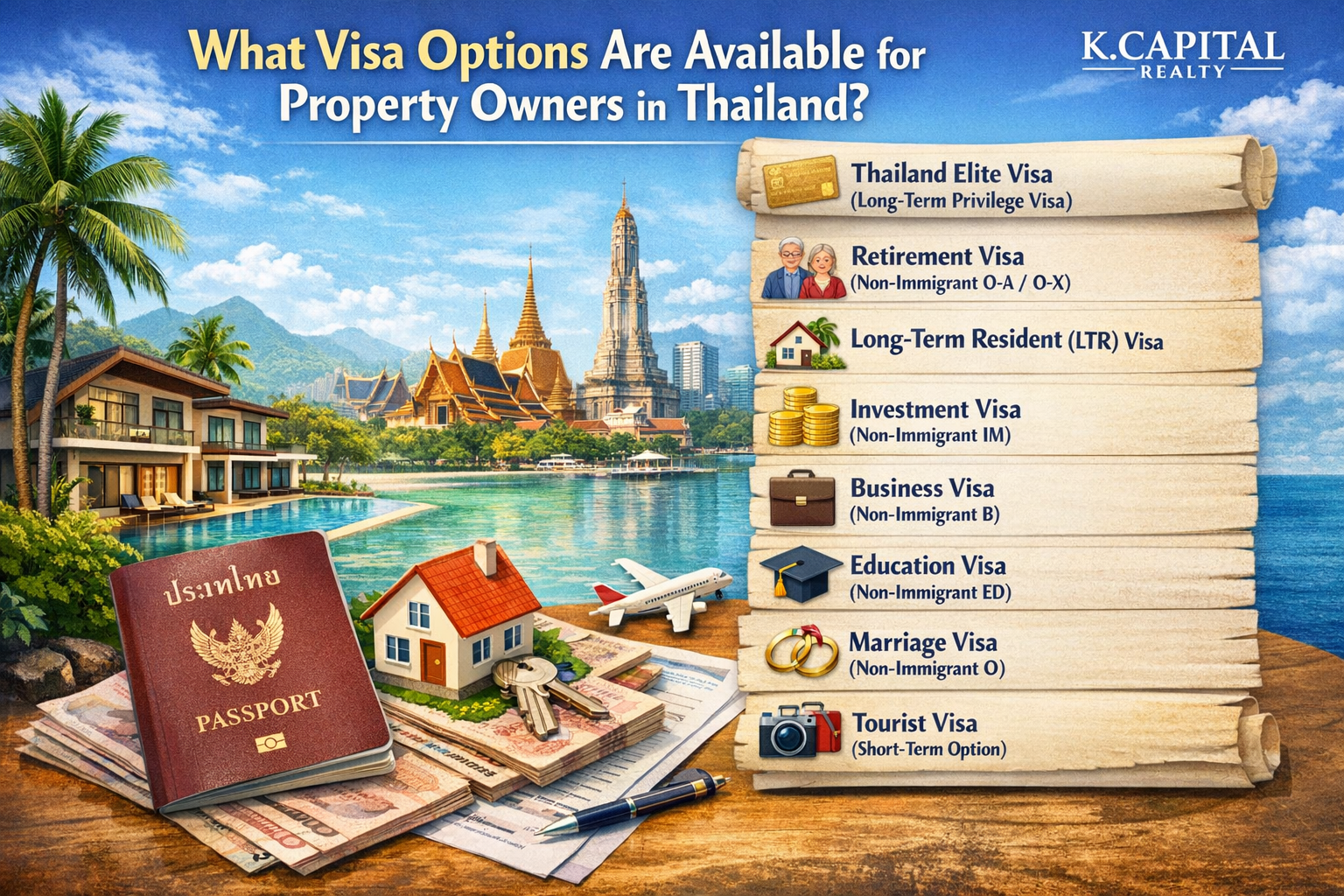
1. Thailand Elite Visa (Long-Term Privilege Visa)
The Thailand Elite Visa is one of the most popular options for foreign property owners seeking convenience and long-term stays.
Key Features:
- Validity: 5 to 20 years (depending on package)
- Multiple entry visa
- No need for frequent visa runs
- VIP immigration services at airports
Requirements:
- Membership fee starting from approx. USD 17,000+
- No income, age, or employment requirements
Why It Works for Property Owners:
This visa is ideal if you:
- Own a condo or villa and want hassle-free long stays
- Prefer not to deal with complex visa rules
- Visit Thailand frequently or live part-time
For many buyers from countries like France, the UK, and Australia, the Elite Visa offers simplicity and peace of mind.
2. Retirement Visa (Non-Immigrant O-A / O-X)
If you’re aged 50 or above, the Thai retirement visa is one of the most accessible options.
Key Features:
- Long-term stay (1 year, renewable)
- Available as:
- O-A Visa (1 year renewable)
- O-X Visa (5–10 years for certain nationalities)
Financial Requirements:
- Bank deposit of 800,000 THB (~USD 22,000), OR
- Monthly income of at least 65,000 THB (~USD 1,800), OR
- Combination of both
Why It Works for Property Owners:
Owning property complements this visa because:
- You already have a residence
- It strengthens your financial profile
- It makes long-term living more practical
This is especially popular among retirees from the following:
- UK
- Germany
- Switzerland
- Scandinavia
- Australia
3. Long-Term Resident (LTR) Visa
Introduced by the Board of Investment Thailand, the LTR visa is a premium long-term visa designed for wealthy individuals and professionals.
Categories include:
- Wealthy Global Citizens
- Wealthy Pensioners
- Work-from-Thailand Professionals
- Highly Skilled Professionals
Key Benefits:
- 10-year visa
- Fast-track immigration
- Reduced reporting requirements
- Work permit included (for some categories)
Financial Requirements:
- Minimum USD 80,000 annual income (or lower with additional assets)
- Significant assets or investments
Why It Works for Property Owners:
If you own high-value property in areas like Bangkok or Phuket, this visa:
- Aligns with your investment profile
- Supports long-term residence goals
- Offers tax and lifestyle advantages
This is ideal for high-net-worth individuals from the US, UK, EU, and Singapore.
4. Investment Visa (Non-Immigrant IM)
Thailand does offer an investment-based visa, though it’s more restrictive than many expect.
Key Requirements:
- Minimum investment of 10 million THB (~USD 275,000)
- Investment must be in:
- Condominiums
- Government bonds
- Approved assets
Conditions:
- Property must meet legal foreign ownership rules
- Investment must be maintained
Why It Works for Property Owners:
If your condo purchase meets the threshold, you may qualify for:
- 1-year visa (renewable)
However, this option is less commonly used because:
- It has stricter compliance requirements
- Other visas (like Elite or LTR) are often easier
5. Business Visa (Non-Immigrant B)
If your property investment is tied to a business venture, this visa becomes relevant.
Key Features:
- Allows you to work or run a company in Thailand
- Requires a Thai-registered business
Requirements:
- Company setup with Thai partners (in most cases)
- Work permit
- Financial and employment compliance
Why It Works for Property Owners:
Many investors:
- Buy property
- Start a rental or hospitality business
This visa is common among:
- Entrepreneurs from Russia
- European investors
- Digital entrepreneurs expanding operations
6. Education Visa (Non-Immigrant ED)
Though not directly related to property ownership, this is a flexible short- to medium-term option.
Key Features:
- Stay in Thailand while studying:
- Thai language
- Cooking
- Martial arts (Muay Thai)
Duration:
- Typically 3 months to 1 year (extendable)
Why It Works for Property Owners:
Useful if:
- You recently bought property
- You’re transitioning to a long-term visa
- You want time to explore your options
7. Marriage Visa (Non-Immigrant O)
If you are married to a Thai national, this is one of the most straightforward paths.
Requirements:
- Legal marriage to a Thai citizen
- Financial proof:
- 400,000 THB in a Thai bank OR
- Monthly income of 40,000 THB
Benefits:
- 1-year renewable visa
- Easier financial requirements than retirement visa
Why It Works for Property Owners:
- Provides long-term stay stability
- Works well if you own family property
8. Tourist Visa (Short-Term Option)
For those not ready to commit to long-term visas, tourist visas still play a role.
Options Include:
- 60-day tourist visa
- Visa exemption (30–45 days depending on nationality)
Why It Works for Property Owners:
Many investors initially:
- Visit their property seasonally
- Stay a few months per year
However, this is not suitable for long-term living.
Key Considerations for Property Owners
1. Condominiums vs Villas
Foreigners can legally own:
- Condominiums (freehold)
- Villas (typically leasehold or via company structure)
Your ownership structure does not directly impact visa eligibility, but it can influence:
- Financial documentation
- Legal setup for business visas
2. Tax and Residency Status
Holding a visa does not automatically make you a tax resident. However:
- Staying over 180 days may trigger tax residency
- Thailand has tax treaties with many countries
It’s advisable to consult a tax professional, especially for:
- Rental income
- Overseas earnings
3. 90-Day Reporting
Most long-term visa holders must:
- Report their address every 90 days
Exceptions apply for some LTR visa holders.
4. Health Insurance Requirements
Some visas (especially retirement and LTR) require:
- Valid health insurance coverage
This is particularly important for:
- Older applicants
- Long-term residents
Which Visa Is Best for You?
Here’s a simplified breakdown:
- Best for simplicity: Thailand Elite Visa
- Best for retirees (50+): Retirement Visa
- Best for wealthy investors: LTR Visa
- Best for active investors/business owners: Business Visa
- Best for high-value property investors: Investment Visa
Final Thoughts
While Thailand does not offer a direct visa through property ownership, it provides flexible and diverse visa options that can easily align with your investment goals.
For buyers from Europe, the UK, the US, Australia, Russia, and Singapore, the key is to:
- Choose the right visa based on your lifestyle
- Align your property investment with long-term plans
- Work with legal and visa experts for smooth processing
Owning property in Thailand—whether a sea-view condo or luxury villa—can be the foundation of a rewarding lifestyle. With the right visa strategy, you can turn that investment into a true long-term home in one of Asia’s most desirable destinations.